


The law of returns to scale explains how output behaves in response to a proportional and simultaneous variation of inputs. Increasing all inputs by equal proportions and at the same time, will increase the scale of production. Returns to scale differ from one case to another because of the technology used or the goods being produce. Therefore, it is closely related to economies of scale happening within the business’ production process.
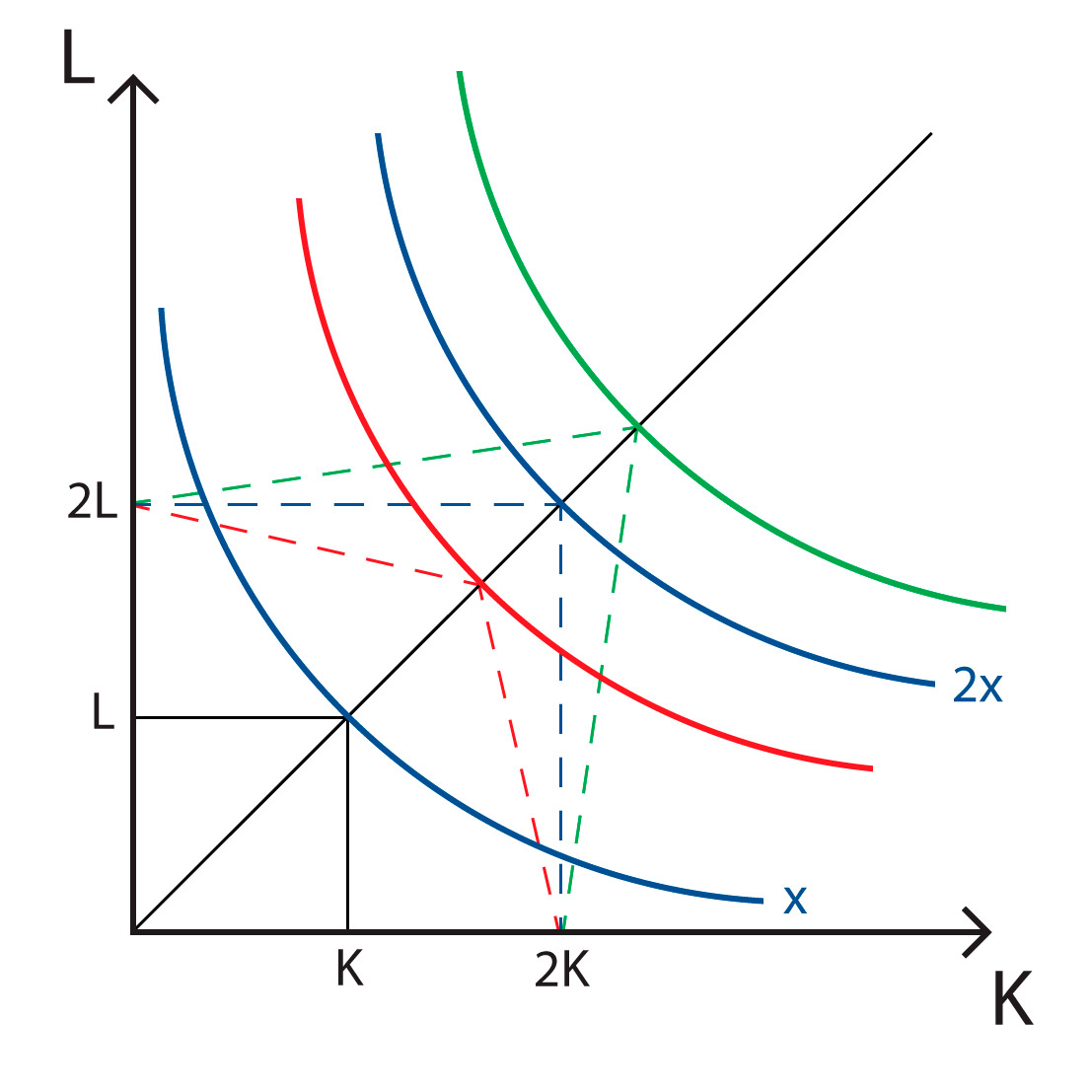
The relation by which output increases compared to the increase in inputs is the return to scale. We can measure the elasticity of these returns to scale in the following way:

That is, the sum of the partial derivatives of production with regards to each factors multiplied by the proportion each input makes up of the whole.
Depending in the proportion by which output increases compared to inputs, there are three different kinds of returns to scale:
-Increasing returns to scale (µ>1): when total output increases more than proportionately (green);
-Constant returns to scale (µ=1): when total output increases proportionately (blue);
-Decreasing returns to scale (µ<1): when total output increases less than proportionately (red).
When dealing with Cobb-Douglas functions, we can also determine which returns of scale are present, since α+β=µ.