


This efficiency criterion was developed by Vilfredo Pareto in his book “Manual of Political Economy”, 1906. An allocation of goods is Pareto optimal when there is no possibility of redistribution in a way where at least one individual would be better off while no other individual ends up worse off.
A definition can also be made in two steps:
-a change from situation A to B is a Pareto improvement if at least one individual is better off without making other individuals worse off;
-B is Pareto optimal if there is no possible Pareto improvement.
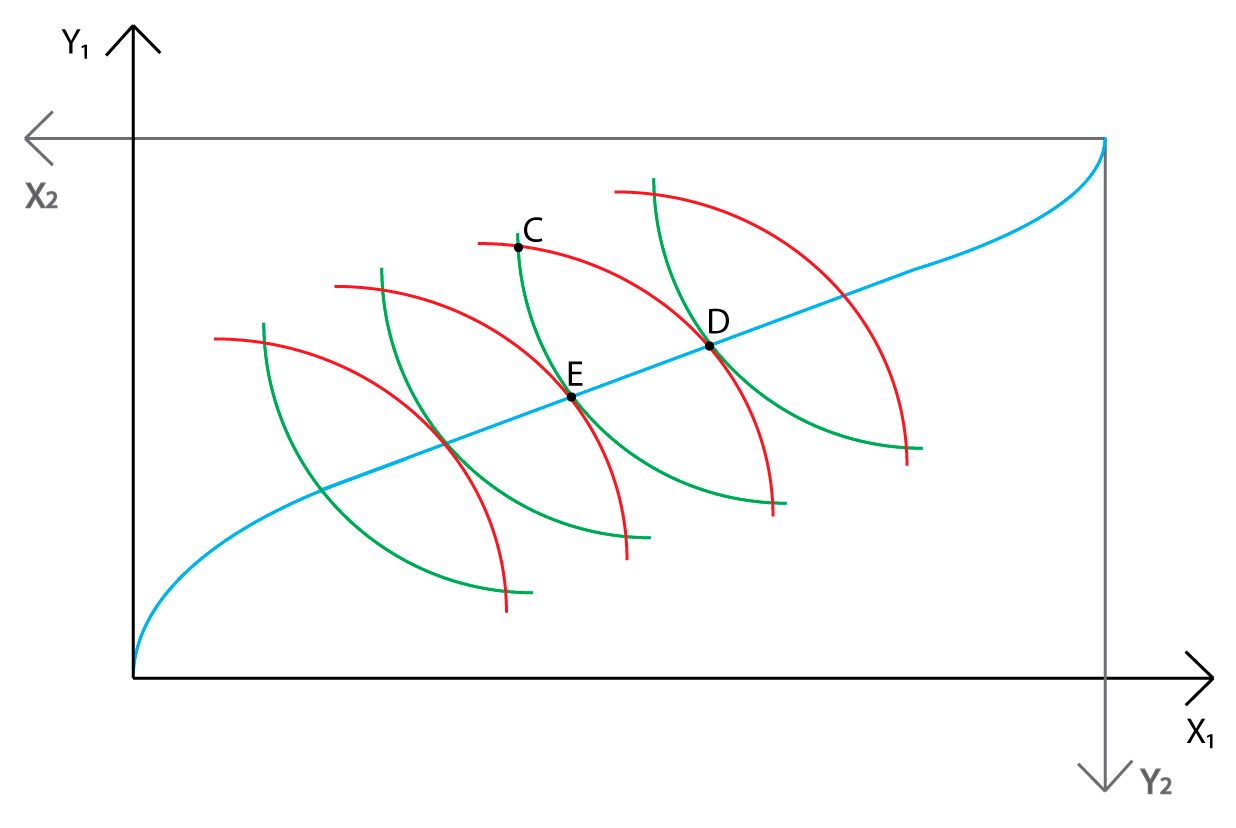 This can be easily understood using an Edgeworth box. Starting from point C, two Pareto improvements can be made:
-from C to D: individual 1 would increase its utility, since a further indifference curve would be reached, while individual 2 will remain with the same utility;
-from C to E: individual 2 would maintain its utility while individual 2 increases theirs.
Once we are at point either D or E, no further Pareto improvements can be made. Therefore, D and E are Pareto optimal.
Following the same steps for every indifference curve, we can say that every point in which indifference curves from different individuals are tangent is Pareto optimal. The curve that links these infinite Pareto optima is called the contract curve.
Video – Edgeworth box: