


First-degree price discrimination, or perfect discrimination, is the highest level of price discrimination, in which each unit of production is sold at the maximum price that the consumer is willing to pay for that specific unit. The firm will gain the entire market surplus it could possibly achieve, as it will sell all the units for the maximum price at which they could be sold.
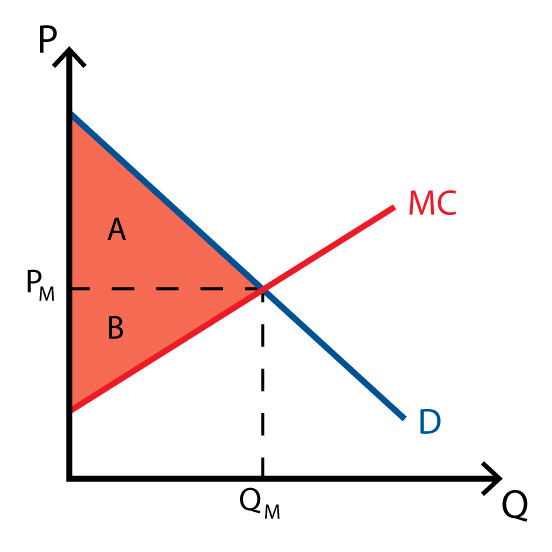 This degree of price discrimination will always have as a result a Pareto efficient level of output as marginal willingness to pay will be equal to marginal cost. For this reason and even though monopolies are associated with this strategy, the production level of output will be the same as in a competitive market, and hence, the inefficiency associated to monopolies will be eliminated. As seen in the adjacent figure, the producer surplus equals total surplus (A+B). There is not deadweight loss, even though there is not consumer surplus (A, which was extracted by the monopoly), and at the end both quantity and price are equal to those that would result from perfect competition.
First-degree price discrimination is, however, quite unrealistic. On the one hand, income elasticity of demand should be equal to zero in order for perfect discrimination to work. On the other hand, there should be imperfect information in the market, since consumers knowing that the price would drop if they showed lower willingness to buy would make them show it, thus making impossible for the monopoly to practice first-degree price discrimination. Knowing the distribution of consumers’ preferences is almost impossible to determine and it is certainly expensive to research. Therefore, in real life, the closest thing there is to perfect discrimination is bargaining reductions in prices (known as second-degree price discrimination) or offering a two-part tariff.