


A multiplant monopoly is given in monopolistic firms that have their production divided into more than one production plant, each one having its own cost structure. Different cost stuctures give place to different marginal costs and hence each production plant will have to choose the individual production output level following the maximising principle. For a monopoly with two plants, we have

where x1 and x2 are the same product, but produced at different plants. This multiplant monopoly will maximise its profits when

where MR is the marginal revenue and MC is the marginal cost in each plant.
The multiplant monopolist will need to decide whether to produce in both plants or just in one plant. This decision depends on each plant’s marginal costs. If it has increasing marginal costs, the multiplant monopoly will produce in either plant, taking into account the marginal total cost of both firms. If there are decreasing marginal costs, it will produce only in one plant, the one with the steepest marginal cost curve, provided it has equal or lower fixed costs than the other plant.
If marginal costs are constant and equal in both plants, the multiplant monopolist can produce in either plant, as long as capacity allows it (see figure below). If demand can be reached with only one plant, the others must be shut down.
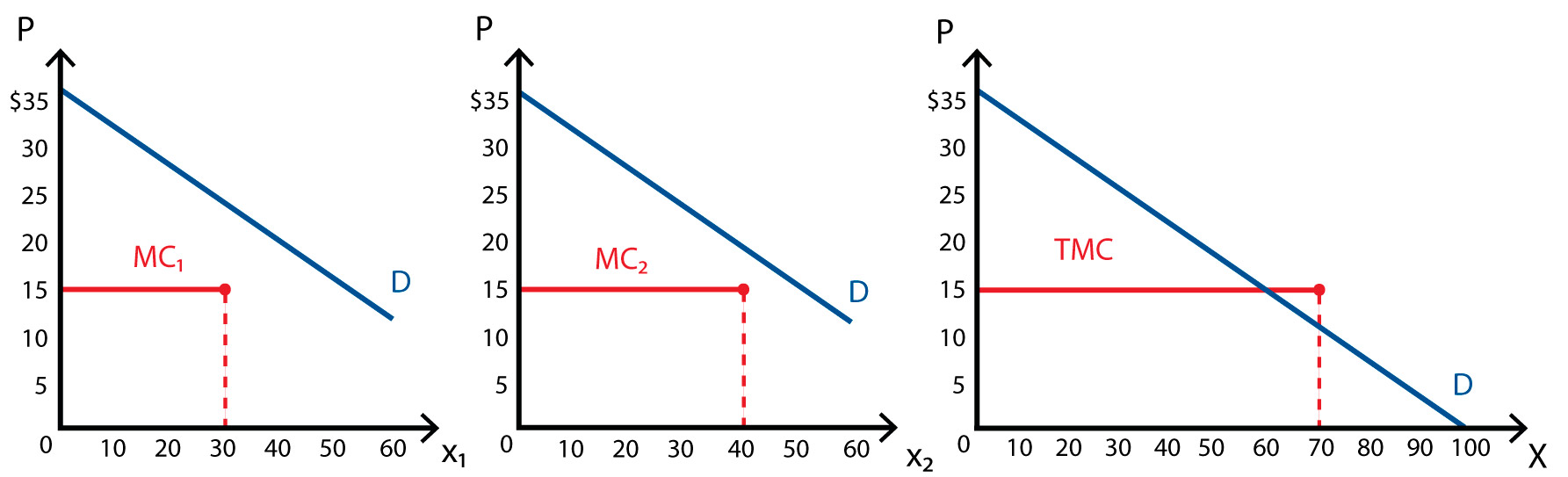
If marginal costs are constant but different in each plant, production should take place only in the plant with lowest marginal costs, as long as maximum capacity is not reached. When this maximum capacity is reached, production will be moved to the other plant, as shown in the figure below.
